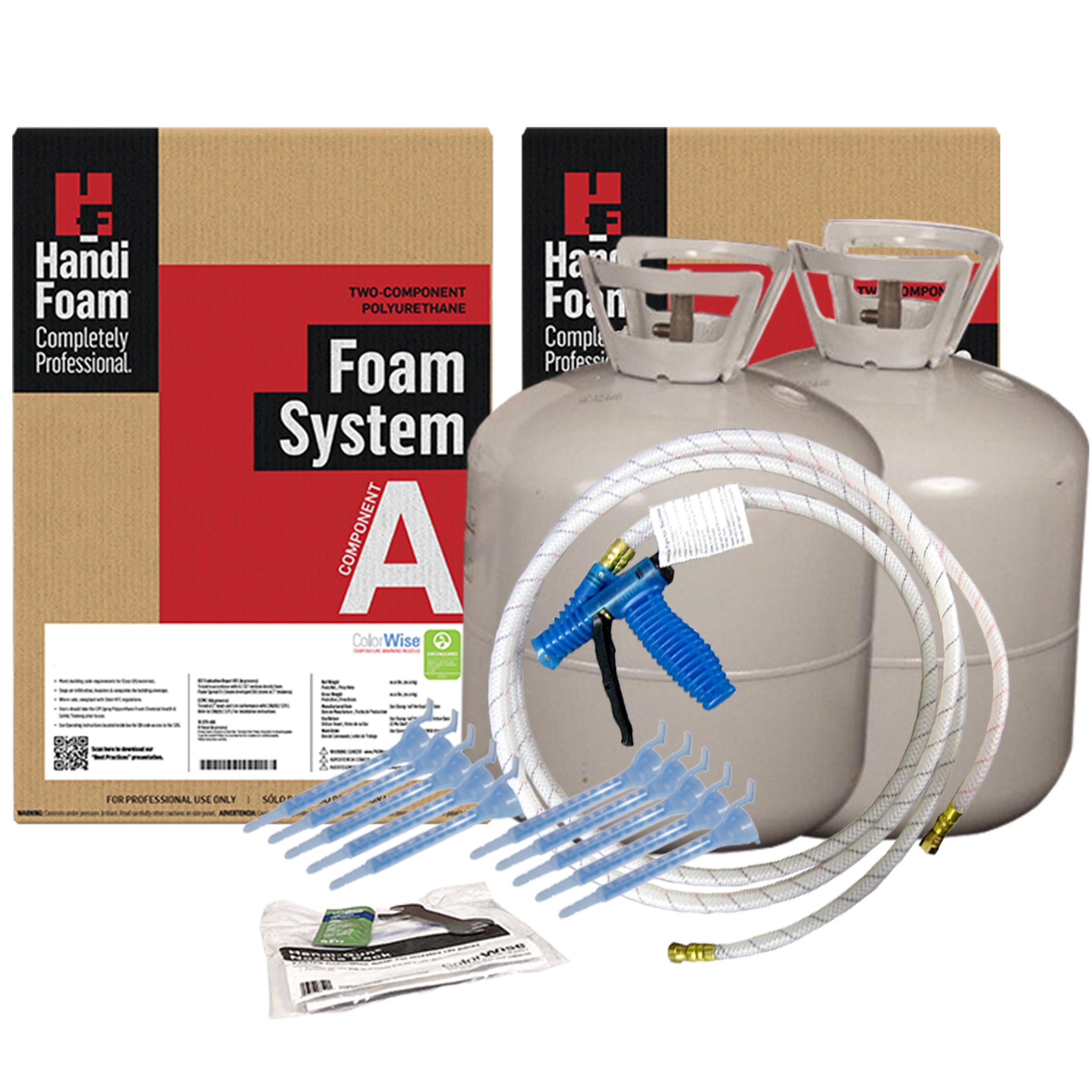
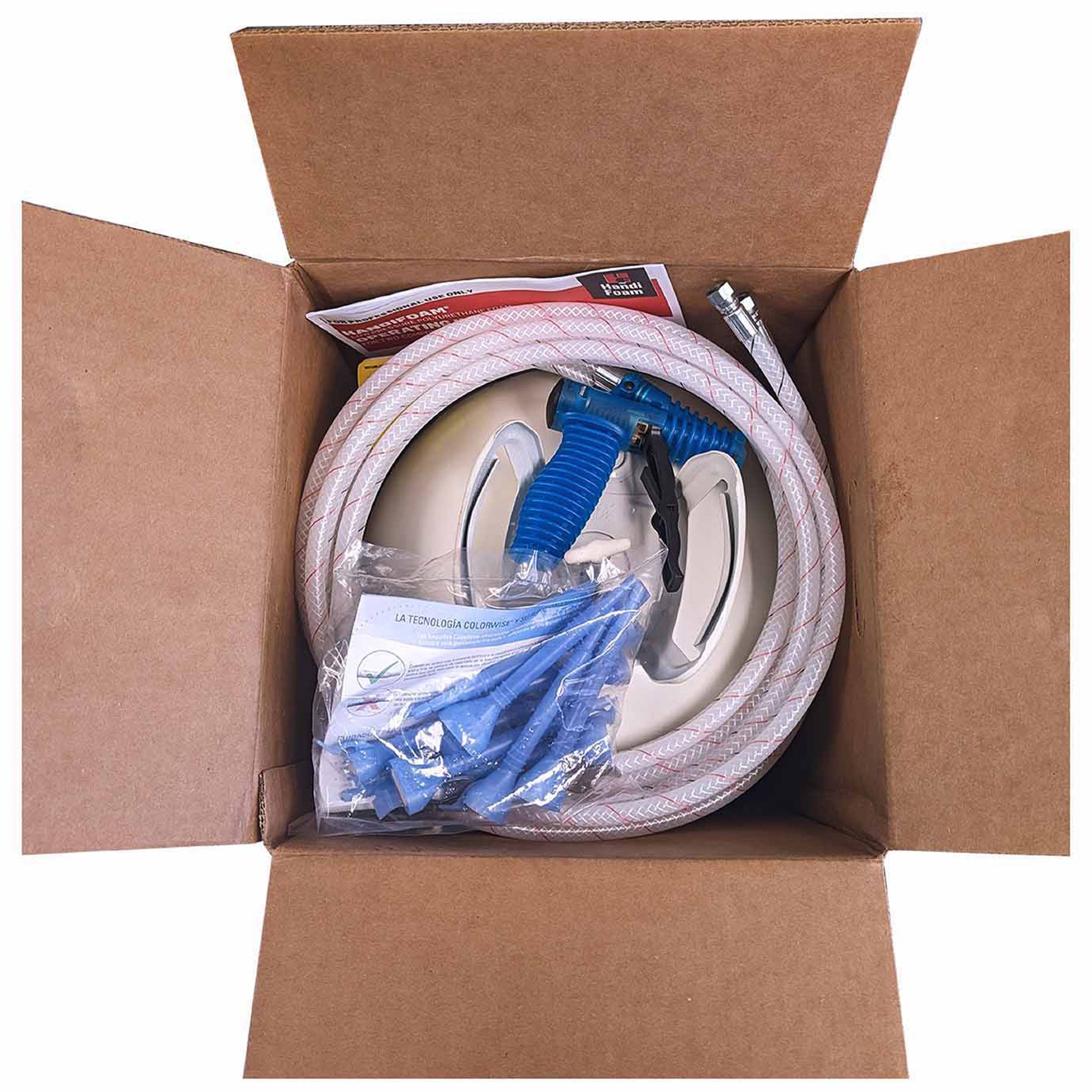
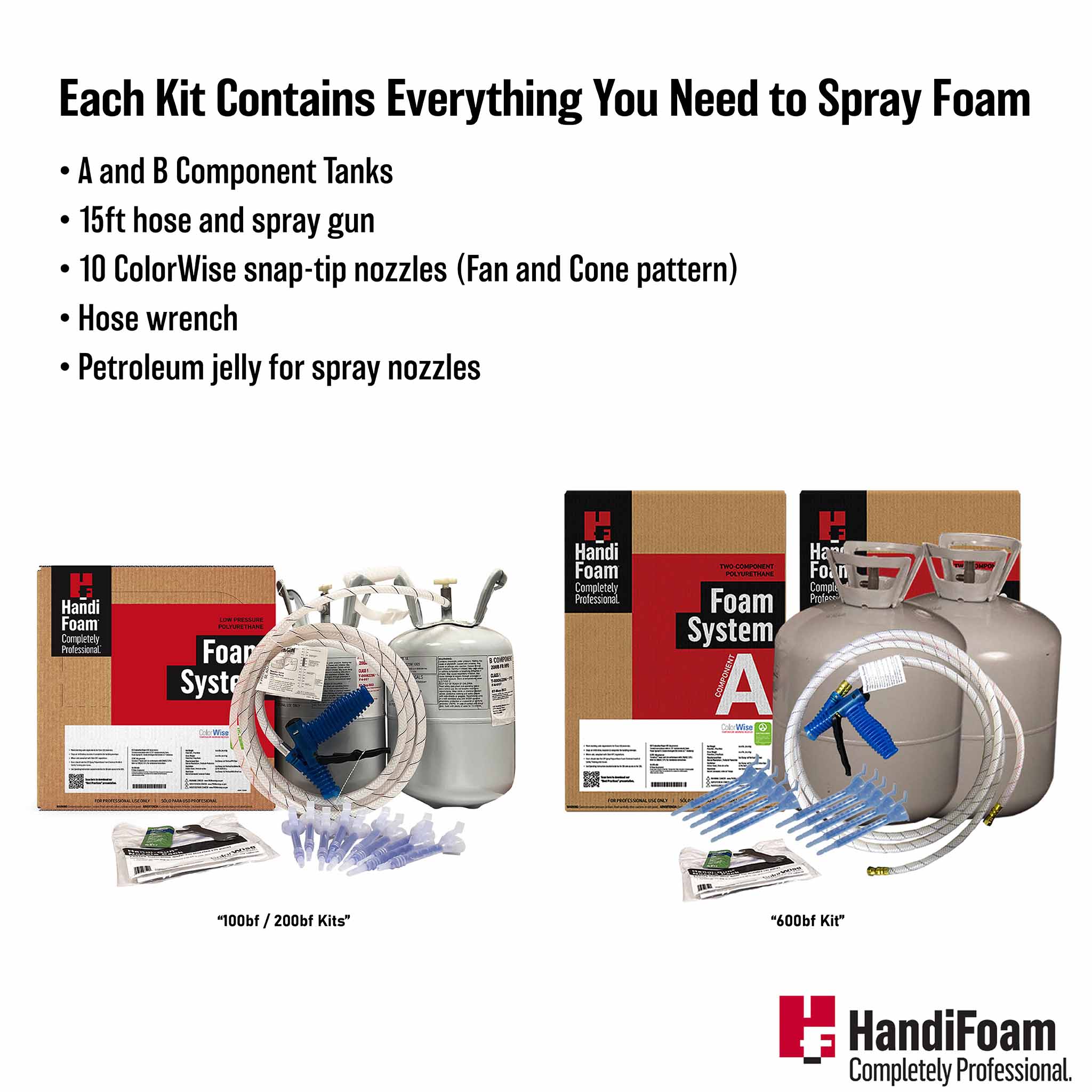
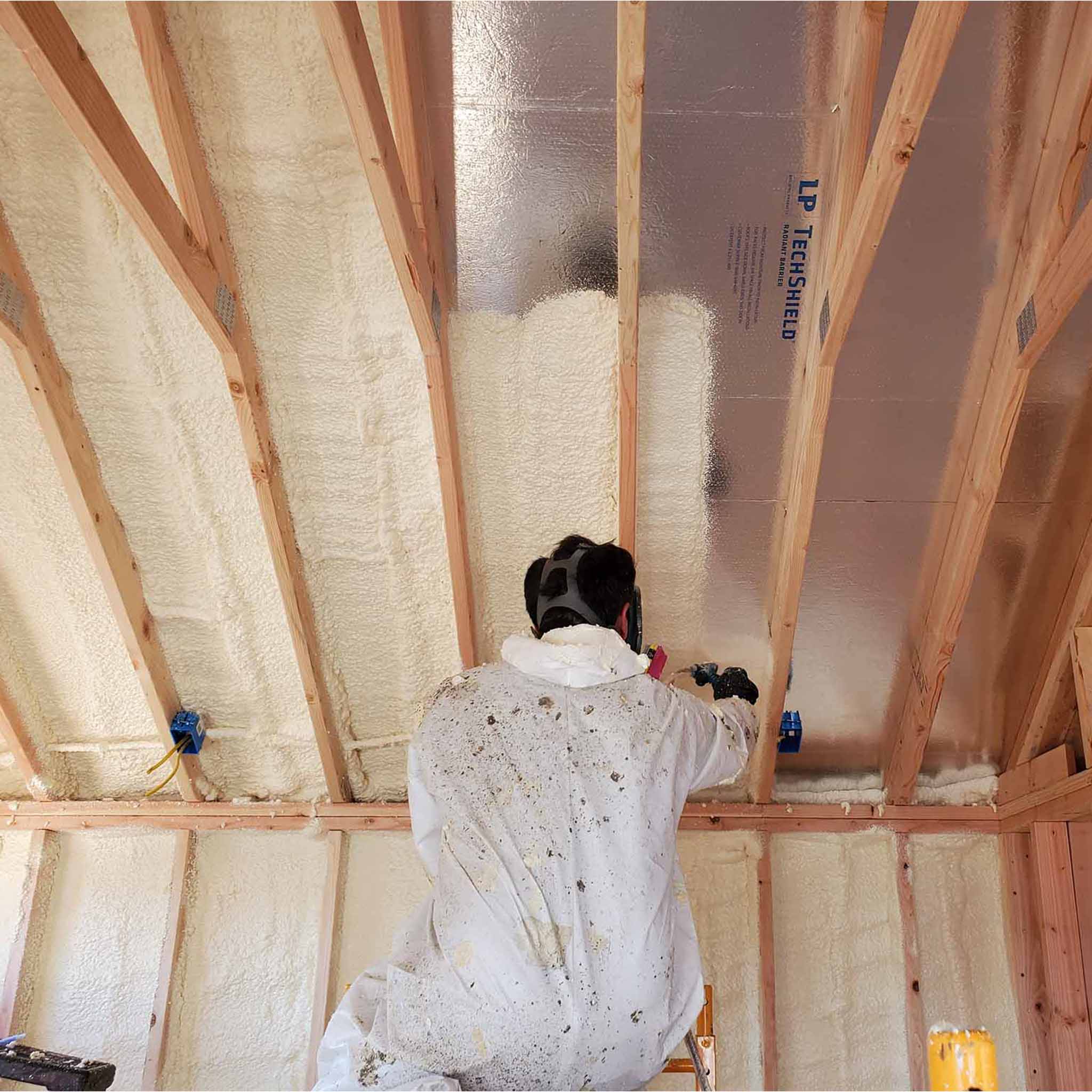
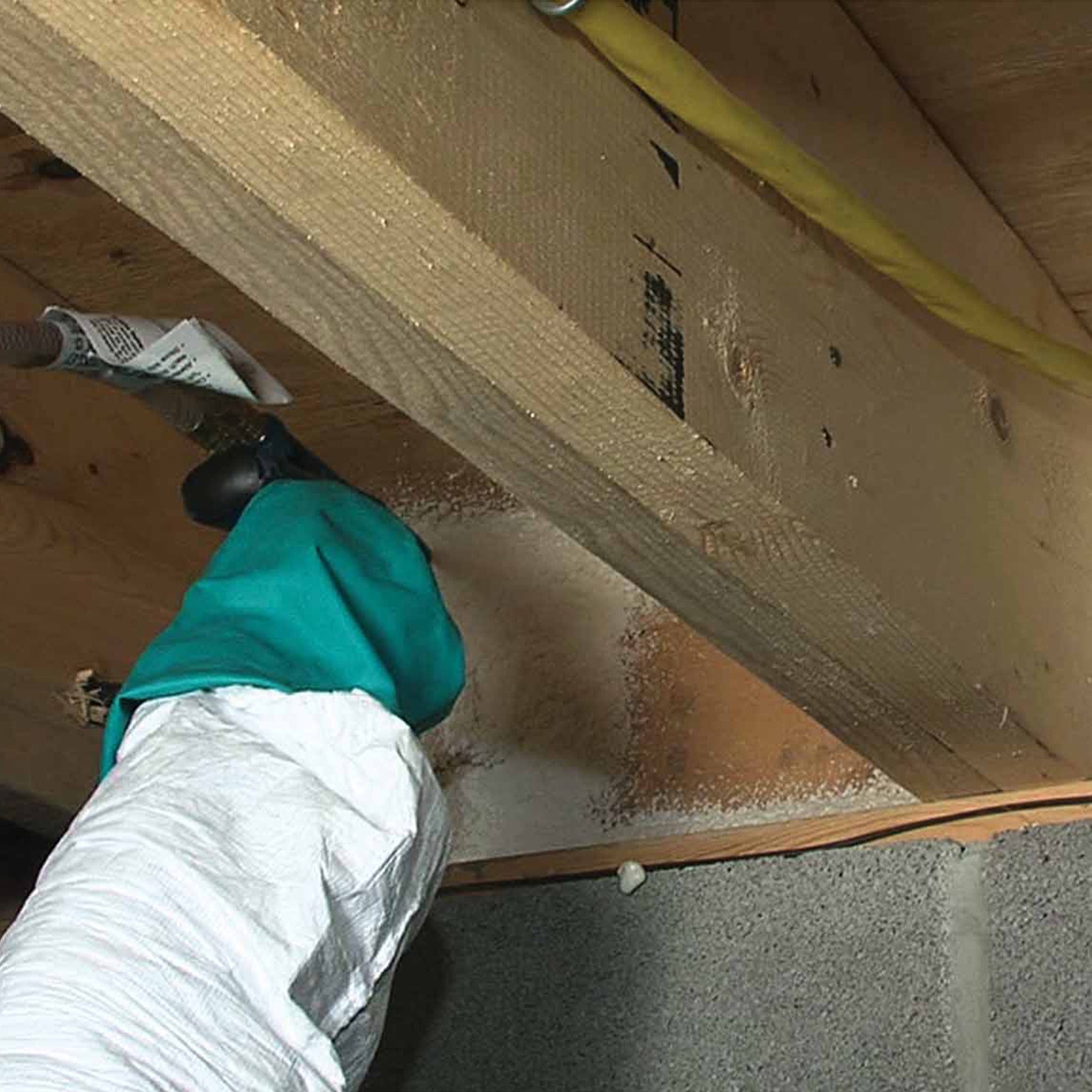
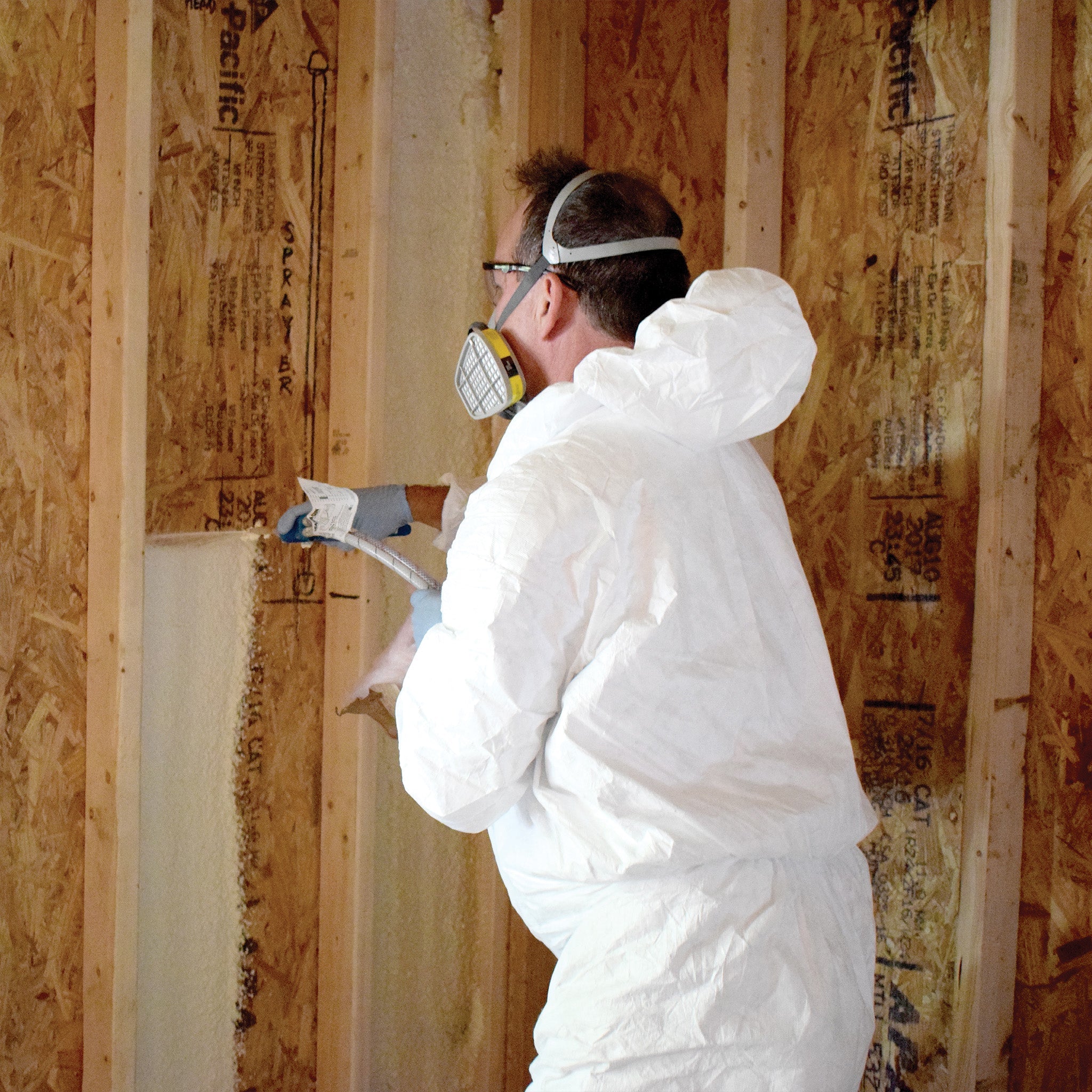
Our most popular closed cell spray foam kit!
If you are looking for foam to insulate your home or building, HandiFoam's® Quick Cure (HFO) 605bf (board foot) closed-cell polyurethane foam kit is the one you're looking for. The P12145 spray foam kit can cover approximately 605 square feet at a 1-inch thickness of expanded foam, making it an ideal option for home or building insulation.
The HFO (closed cell) low pressure spray polyurethane foam kit is a two-component system designed to fill and insulate large voids and surfaces. HandiFoam's® excellent adhesion properties create a continuous air barrier which completes the building envelope, resulting in improved indoor air quality and lower heating and cooling costs.
This product replaces the 605bf HandiFoam Quick Cure (HFC)
P12145 is the replacement for part numbers: P12056, P10762-1, P10762, FOAM605, FOAM605E84
*This kit is manufactured with an environmentally friendly Low GWP (HFO) blowing agent and is AVAILABLE TO SHIP TO ALL STATES.
COMMON USES:
- ✓ Air sealing & insulating attics
- ✓ Metal buildings & pole barns
- ✓ Sealing can lights & duct work
- ✓ RVs & refrigerated trailers
- ✓ Cold storage & storage bins
Specifications
| Coverage (Board Feet*): | 605bf |
| Cured Volume: | 50ft³ |
| Tack Free: | 45-75 sec. |
| Cuttable time: | 2-5 min. |
| Type: | Polyurethane |
| Fire Rating: | Class A (ASTM E-84) |
| Density: | 1.75 lbs/ft³ up to 2.1 lbs/ft³ |
| R-Value: | 6.6 per inch initial |
| Closed Cell: | Yes |
| Perm Rating: | 1.6 (1") |
| MFTR Part No: | P12145 |
| Shipping Weight: | 116 lb |
Installation Tips
- Temperature: Spray foam products are temperature sensitive. You can spray this kit in colder outdoor temperatures, the key is to keep the core temperature of the tanks within the proper range of 75-85°F.
- Change Nozzles: It is important to change the nozzle after you stop spraying for more than 30 seconds. Failure to change nozzles may result in damage to the spray gun.
- Reuse Nozzles: It is possible to clean and reuse a nozzle 2-3 times. As soon as you are done spraying, remove the nozzle and drop it in a can of acetone. You can also use our Handi-Cleaner to clean out uncured foam.
- Safety Considerations: Our Safety Kit includes a tyvek suit with hood, respirator, goggles, and 2 pairs of nitrile gloves.
- Application: Use a slow, steady, and smooth motion to spray a continuous layer when applying the foam. Spray what appears to be just under a 1/4" thickness and it will expand and cure to roughly 1 inch. Apply additional layers until desired thickness is achieved, allowing at least 10 minutes between layers.
- Clean Up: You can clean up uncured foam with Handi-Cleaner. Once foam is fully cured, you will have to remove it by mechanical means.
- More Details: Download the full Operating Instructions (pdf)
Installation Videos
Calculate Your Savings
Enter your attic dimensions to estimate material needs and annual cooling bill savings.
Estimated Project ROI
Easy 30-Day Returns & Fast Shipping
We take pride in our products and want you to be completely satisfied with your purchase. If you have leftover rolls or ordered the wrong size, we are here to help.
- Shipping: Orders placed before 2 PM CT ship out the same business day. Free ground shipping applies to all orders over $150.
- Returns: Unused rolls in their original packaging can be returned within 30 days of purchase.
- Support: Have installation questions? Call our dedicated team at +1 877 464 5828.
1. Properly prepare the kit before spraying.
Read the installation instructions and our Tips & Tricks guide before beginning. Tanks should be conditioned to approximately 75–85°F, hoses should be snugly connected without over-tightening, and the cylinders should be thoroughly shaken. Before installing a nozzle, perform a test shot and verify that two even streams of chemical are exiting the gun.
2. Change nozzle tips frequently.
A nozzle should generally be replaced whenever spraying stops for more than 30 seconds. Continuing to spray with a partially cured nozzle can result in poor mixing and off-ratio foam. If anything looks unusual, remove the tip and perform another test shot before continuing.
3. Monitor the foam as you spray.
Maintain consistent spray technique, holding the gun approximately 12 inches from the surface while moving at a steady pace. Surfaces should be clean, dry, oil-free, and between 40°F and 95°F. Properly mixed closed-cell foam should expand predictably, cure to a pale yellow color, and feel firm after curing. If the foam appears abnormal, stop and diagnose the issue before proceeding.
A board foot is a unit of volume used throughout the spray foam industry. One board foot is equal to one square foot of coverage at one inch of thickness.
For example:
- 605 board feet = 605 square feet at 1 inch
- 302 square feet at 2 inches
- Approximately 202 square feet at 3 inches
- Approximately 50.4 cubic feet of foam volume
Board feet provide a standardized way to compare foam yields regardless of application thickness.
This closed-cell spray foam provides an initial R-value of approximately R-6.6 per inch. Over time, the aged R-value stabilizes at approximately R-6.1 per inch. The high R-value per inch allows closed-cell foam to provide excellent thermal performance in applications where cavity depth is limited.
The answer depends on the application. For foam installed inside wall cavities during a typical construction project or remodel, it is common for the foam to remain exposed for days or even weeks before drywall is installed. Because sunlight exposure is limited indoors, UV degradation is generally minimal during normal construction timelines.
For exterior walls, exposed ductwork, or other applications subject to direct sunlight, the foam should typically be covered, coated, or painted within approximately seven days. Ultraviolet (UV) exposure gradually degrades the outer skin of the foam and can eventually affect long-term performance.
For horizontal applications where waterproofing, water proofing, or weather protection is important, it is best to coat or seal the foam the same day it is sprayed. Prompt sealing helps preserve both the waterproof characteristics and long-term durability of the foam.
Proper PPE is essential when spraying foam insulation. At a minimum, installers should wear:
- A P95 respirator equipped with organic vapor cartridges
- Protective goggles or full eye protection
- Chemical-resistant gloves
- Full-body protective clothing or coveralls
The respirator should be capable of filtering airborne oil-based mists and particles that may be present during spray foam application.
The work area should also be kept well ventilated, and fans should be used whenever possible to maintain air movement and reduce exposure concentrations. If you wear prescription glasses, take extra care to protect them from overspray, as cured foam can be extremely difficult to remove.
This 605 board foot insulation kit covers approximately 605 square feet at one inch of thickness.
For example, if your project requires approximately 2 inches of closed-cell foam to achieve an R-value near R-13, expected coverage would be approximately 302 square feet.
Actual yield can vary based on several factors, including:
- Chemical temperature
- Surface temperature
- Spray technique
- Distance from the substrate
- Application thickness
- Environmental conditions
Proper preparation and spraying technique are critical for achieving maximum yield.
The HandiFoam spray foam brand has earned a reputation for producing exceptional foam and some of the best supporting components available in the spray foam kit industry.
The closed cell foam provides a tight, uniform cell structure with a durable outer skin that is firm and water proof. The open-cell formulations maintain water vapor permeability as designed while providing consistent density and performance.
HandiFoam's ColorWise® nozzle includes several installer-friendly features. The nozzle tips turn blue when chemical temperatures become too cold, helping identify potential temperature-related issues before they affect foam quality. Each nozzle has a break off tab also that allows installers to select either a fan spray pattern or a circular cone spray pattern before installation.
The applicator gun itself is durable, and the trigger is constructed from a robust plastic design that is far less prone to cracking or breaking than many competing systems.
The foam color itself can also be a useful troubleshooting tool. Properly mixed foam cures to a pale yellow color, while a color continuum ranging from brown to off-white can help identify potential off-ratio conditions and aid in diagnosing installation issues.
At Energy Efficient Solutions, we provide more than just high quality products—we provide the knowledge and expertise needed to help customers achieve successful results. Whether you're working on a home remodel, a metal building, an OEM manufacturing project, or a commercial application, our team has years of experience helping customers choose the right products and use them effectively.
We understand how spray foam fits into the bigger picture of creating a more energy-efficient building and can help guide you toward the best solution for your specific project.
One of the most important factors in any spray foam job is achieving maximum yield and proper foam quality. Something as simple as incorrect temperatures, poor spray technique, or a missed troubleshooting step can significantly impact the performance of a kit and increase the overall cost of the job.
That's why we include our proprietary Pro Sheet with every order. It contains installation tips, troubleshooting guidance, and best practices developed from years of real-world experience. We regularly help customers understand topics such as proper tank temperatures, performing a test shot without a tip, changing nozzle tips at the correct intervals, and maximizing foam yield.
Our goal is simple: help you complete your project successfully the first time while getting the most value possible from your investment.
The answer depends on your application, climate, performance goals, and budget.
Closed cell spray foam provides one of the highest R-value ratings per inch of any commonly available insulation product. It also creates an exceptional air seal, helping keep conditioned air indoors during both summer and winter months. Depending on the product, closed cell foam typically ranges from approximately 1.75 lb/cf to 3 lb/cf density and is considered water proof once cured.
Closed cell foam is commonly used in:
- Exterior walls
- Cathedral ceilings
- Roof rafters
- Metal buildings
- Hog pens
- Shipping containers
- Marine applications
- Industrial facilities, including nuclear power plants
Open cell foam is often used in southern, hot, humid climates where allowing water vapor and humidity to move through the insulation assembly is desirable. Open cell foam is generally less expensive per volume than closed cell foam, making it a popular choice for filling larger wall cavities.
At approximately 3 inches of thickness, open cell foam functions as an effective air barrier and seals very well while providing excellent sound control and thermal performance.
Choosing between open cell and closed cell foam depends on the specific goals of your project, and we're always happy to help determine which option is the better fit. Contact our customer service team for more help, or feel free to review this article to further clarify the difference between the two better.
Not necessarily. For many applications, closed cell spray foam can achieve the required insulation performance without filling the entire cavity. For example, approximately 2 inches of closed cell foam typically provides an insulation value near R13, which is often sufficient for many wall assemblies. Open cell foam is commonly installed at 3 inches or greater thickness and can easily fill the entire depth of a standard 2x4 wall cavity when desired.
The appropriate thickness depends on your climate zone, building design, and local building codes. Always consult applicable code requirements for your area before determining final insulation thickness.
Officially, manufacturers generally recommend using the entire kit within a relatively short period after initial activation, which is typically within a few weeks and often no more than approximately 30 days. It is also beneficial to spray a small amount of foam every few days to help keep chemicals moving through the hoses and system. Unofficially, many customers have successfully stored partial kits for use later by taking additional precautions.
While these methods are not officially guaranteed by the manufacturer, many experienced users have successfully extended the usable life of partially used kits by following these practices:
- Fully close the cylinder valves and spray HandiFoam Handi-Cleaner into the valve openings to help remove any uncured foam residue.
- Apply petroleum jelly (Vaseline) inside the valve openings to help create an air seal.
- Cover the valve openings with a plastic bag and secure them using a zip tie or rubber band for additional protection.
- Remove chemicals from the hose/gun assembly and carefully clean the components using compressed air and, where appropriate, small amounts of acetone.
The first step is simple: stop spraying and diagnose the issue before continuing.
If the foam appears brown, white, brittle, sagging, dripping, unusually soft or fluffy, or otherwise different from what you expect, there is likely an issue that should be addressed before proceeding.
Start by removing the nozzle tip and performing a test shot into a waste container. You should see two strong, even streams of chemical exiting the gun. If one side has noticeably less pressure than the other, the issue may be related to the hose assembly, gun, or chemical delivery system.
Next, verify chemical temperatures using an infrared thermometer. For most applications, both cylinders should be conditioned to approximately 80°F before spraying.
Other common troubleshooting steps include:
- Confirming both cylinder valves are fully open
- Checking hose connections
- Verifying the chemicals were properly shaken
- Confirming the substrate temperature is within the recommended range
- Inspecting the spray pattern and foam color
Many foam issues can be resolved quickly once the root cause is identified. If you're unsure what you're seeing, contact us and we'll help walk you through the debugging process to get your project back on track.